Understanding Attention: Key Concepts and Implications for Cognitive Processing
By Talent Navigator
Published Jan 12, 2025
4 min read
Attention is a complex cognitive function that plays a crucial role in how we interact with our environment. It enables us to focus on specific stimuli while filtering out distractions, allowing for effective decision-making and learning. In this article, we will delve into the multifaceted nature of attention, its measurement techniques, and its implications for cognitive processing and real-world applications.
What is Attention?
Attention can be defined as the cognitive process of selectively concentrating on one aspect of the environment while ignoring others. This selective focus is vital for efficiently navigating our surroundings and responding to stimuli that require our immediate response.
Key Models of Attention
Understanding how attention works can be approached through various theoretical models, each providing a unique perspective on the cognitive processes involved.
1. Spotlight Model of Attention
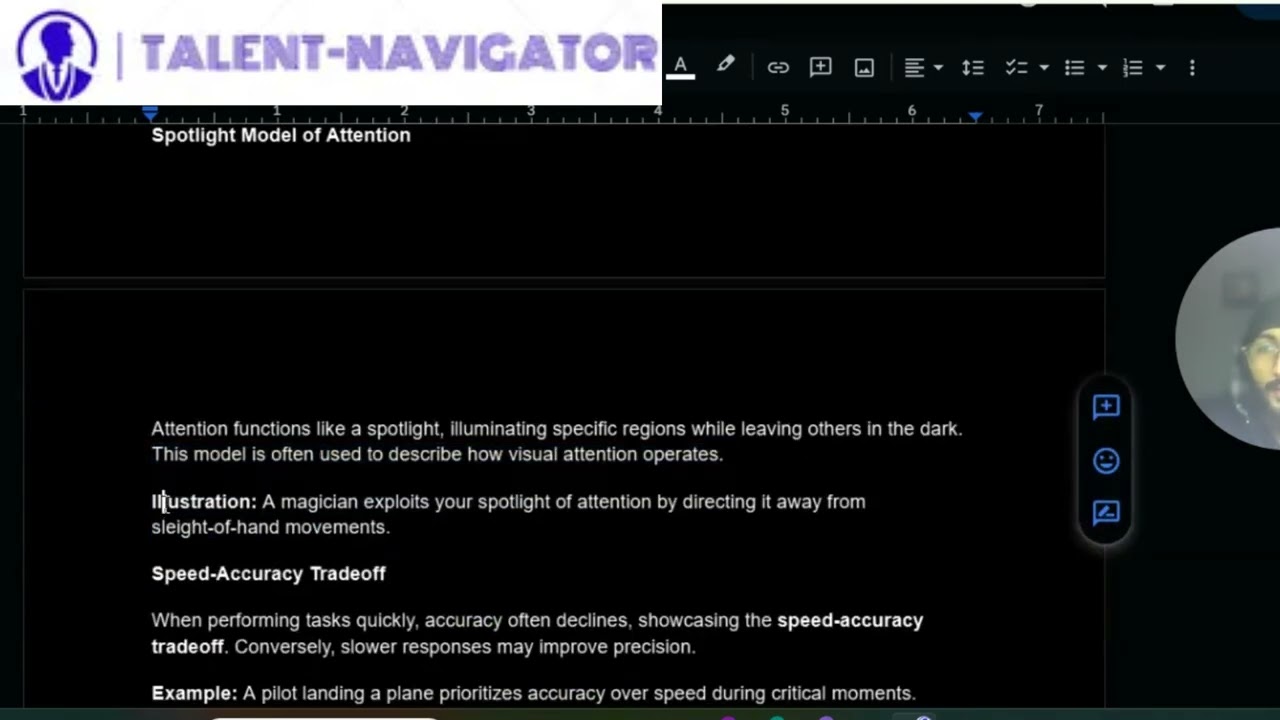
The spotlight model of attention visualizes our focus as a spotlight illuminating specific areas while leaving others in darkness. This model helps explain how we can zero in on particular objects or stimuli, akin to a magician directing our gaze away from their sleight of hand.
2. Psychological Refractory Period (PRP)
The Psychological Refractory Period (PRP) refers to the delay that occurs when processing a second task closely follows the first. This bottleneck happens due to the finite nature of cognitive resources. For instance, if you try to respond to a text while also hearing a sudden knock at the door, your reaction may be delayed because your attention is split.
How is Attention Measured?
Researchers employ various techniques to study attention by observing brain activity and cognitive processes.
1. Intracellular and Extracellular Recording
Intracellular recording involves inserting an electrode into a neuron to measure voltage changes, providing detailed insights into individual neuronal activity. In contrast, extracellular recording detects the summed activity of groups of nearby neurons, offering a broader view of neural communication.
2. Functional MRI (fMRI)
Functional Magnetic Resonance Imaging (fMRI) measures brain activity by detecting changes in blood flow, enabling researchers to map attention networks and cognitive processes. While fMRI excels at spatial resolution, it does not capture rapid neural dynamics effectively.
3. Electroencephalography (EEG)
EEG utilizes scalp electrodes to measure electrical activity in the brain, allowing researchers to capture rapid changes associated with attention. This method is highly sensitive to temporal shifts, enabling the analysis of milliseconds of neural activity, unlike the slower responses of fMRI.
The Trade-Off of Speed and Accuracy
A crucial aspect of attention is the speed-accuracy trade-off. When tasks are performed quickly, accuracy often declines. Conversely, taking additional time can enhance precision, which is especially critical in scenarios such as landing an aircraft, where safety allows for slower, more deliberate responses.
Eye Tracking and Pupil Dynamics
Eye tracking technology measures gaze patterns and movements, providing insights into attention, cognitive load, and learning. Changes in pupil size can reflect emotional arousal and cognitive effort, making eye-tracking an invaluable tool for studying disorders like ADHD and usability in design.
Signal Detection Theory
Signal Detection Theory helps understand decision-making under noise. It categorizes performance based on two main concepts:
- Hit Rate: The proportion of correctly identified signals.
- False Alarm Rate: The rate of misidentifying noise as a signal.
The theory highlights how operators, like radar technicians, must balance hits and false alarms to maintain optimal performance when identifying critical signals.
Receptive Fields and Sensory Processing
A receptive field is the specific sensory space where a stimulus can influence the firing of a neuron. In sensory systems, particularly the visual system, receptive fields determine how neurons respond to features such as motion and orientation. Understanding receptive fields is essential for grasping how attention impacts perception and cognitive processing.
Implications of Attention in Real-World Applications
Attention is not merely an abstract concept; it has profound implications in various fields, including education, artificial intelligence, and user experience design. By unlocking the mysteries of attention, we can enhance learning methodologies, improve systems for information consumption, and create better AI tools that align with how humans process information.
Conclusion
Attention remains one of the most intricate cognitive processes, influenced by both internal and external factors. From understanding the spotlight of attention to leveraging advanced measurement technologies like EEG and fMRI, comprehending how our attention works is vital for numerous applications. By recognizing and applying these concepts, we can enhance cognitive function and improve learning and decision-making strategies in a rapidly evolving world.
To continue exploring the nuances of cognitive processes and how they can be applied in practical settings, consider diving deeper into related topics such as decision-making under uncertainty or the challenges of multitasking in today’s information-rich environment.


Comments
Post a Comment