Exploring Inhibition of Return: Sensory Perception Mechanics in Humans and Animals
By Talent Navigator
Published Apr 20, 2025
5 min read
Understanding Inhibition of Return
Inhibition of Return refers to the cognitive mechanism that slows down our response to stimuli in locations that we have previously attended to. This phenomenon is believed to encourage exploration behavior by reducing the likelihood that we will re-examine areas we have already observed. Initially identified in visual attention experiments by Posner and Cohen in 1984, IOR has since been studied across various contexts and species.
Key Features of Inhibition of Return
The IOR mechanism operates based on spatial location rather than objects. When a stimulus is presented, the likelihood of our attention being directed back to that particular spot decreases based on our prior engagement there. This spatially based process also highlights the automatic nature of attention, wherein reactions to visual stimuli occur swiftly and unconsciously.
Mechanisms of IOR
- Spatial Location: IOR is strongly tied to the previous engagement of a specific spatial location rather than the objects themselves in that location.
- Automatic Processes: The effects of IOR occur automatically, diminishing reactions to previously attended spots, typically noticeable about 300 milliseconds after the initial stimulus presentation.
- Temporal Dynamics: Research indicates a clear time-dependent relationship; the longer the delay after the first stimulus, the stronger the IOR effect that can be observed.
Experimental Insights into IOR
Research on IOR has been conducted through various experimental designs, typically involving participants fixating on a central point. An adjacent cue, often in the periphery, attracts attention. Depending on how quickly a target appears at a cued or uncued location, response times will vary.
Key Findings from IOR Experiments
- Faster Responses: Targets that appear shortly after a cue at the cued location (less than 200 milliseconds) elicit quicker reaction times compared to those that appear at uncued locations.
- Slower Responses: Conversely, when a delay of over 300 milliseconds is introduced, people take longer to react to targets appearing at previously attended locations.
- Object-Based IOR: Notably, IOR can also manifest in experiments where objects move from one location to another while maintaining attention on the object itself. This indicates that the IOR is linked to the object rather than merely the fixed location.
IOR in Different Contexts
Investigating Negative Priming
Negative priming refers to when a previously ignored stimulus slows response times in subsequent trials. A study conducted by Tipper and Driver explored this, affirming that response delays occur when targets appear in previously ignored locations, demonstrating how IOR can shape attentional dynamics and cognitive processing.
Location-Based vs. Object-Based Attention
A significant aspect of IOR is its differentiation between location-based and object-based mechanisms. IOR acts somewhat differently when attention is focused on spatial locations versus physical objects:
- Location-Based IOR: This operates under the premise that our brain has a tendency to ignore previously focused locations in future trials, prolonging reaction times at those spots.
- Object-Based IOR: Research suggests that even when objects within attended spaces change locations or configurations, our response can still be hindered if they were previously regarded as distractors.
Role of Distractor Positioning
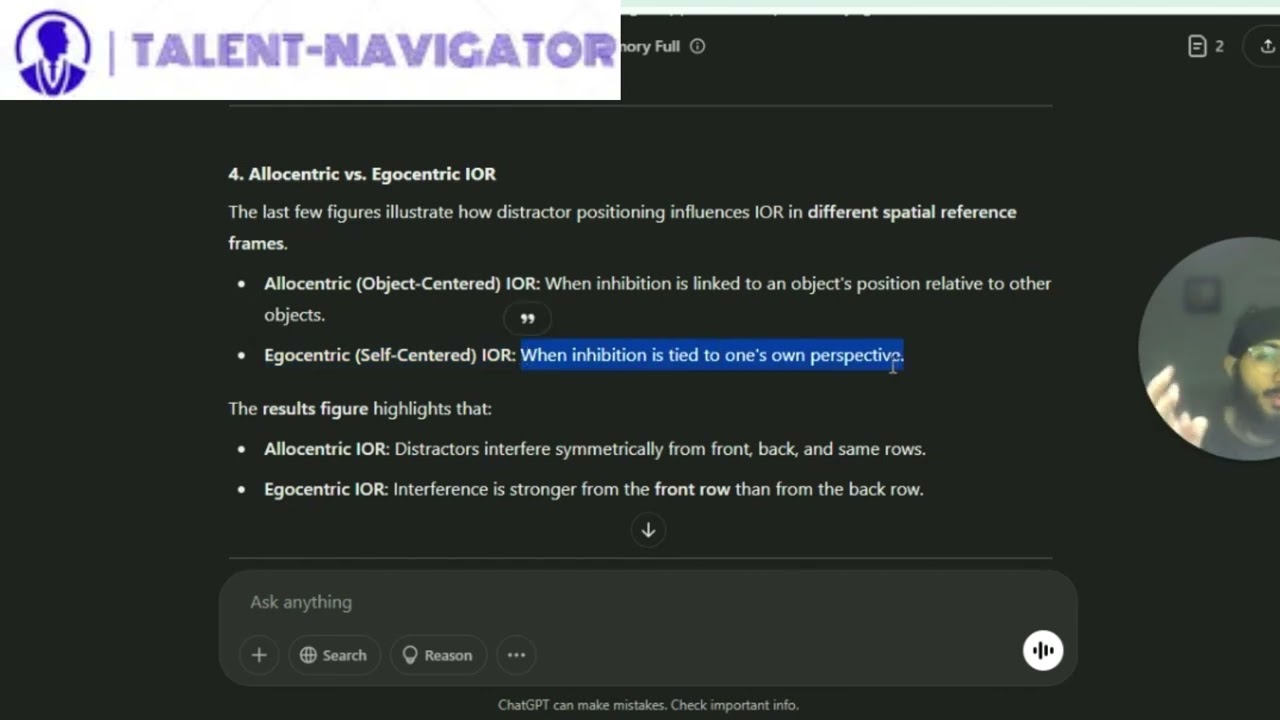
An overlooked factor in IOR research is how the placement of distractors can influence reaction times. Studies have shown that distractors positioned near the target can increase the likelihood of slower responses, demonstrating a strong effect from distractors that are proximal to previously attended locations. For instance, positioning distractors in the front row compared to the back row significantly impacts reaction outcomes, leading to longer processing times when targets are introduced.
Implications of IOR in Real-World Settings
Understanding IOR doesn't just enhance our grasp of sensory perception; it also sheds light on real-world applications:
- Field of Attention: Practically, IOR underlines why people miss objects or stimuli in their periphery when they are focused on a particular task or area, contributing to phenomena like inattentional blindness.
- Behavioral Insights: By examining these attentional biases, researchers can better understand behavioral tendencies in both humans and animals. This insight can be crucial in various domains, including wildlife observations, cognitive training, and even marketing strategies that hinge on visual focus.
Conclusion: Appreciating the Complexities of Attention
In conclusion, Inhibition of Return serves as an integral component of our cognitive architecture, significantly shaping how we engage with the world. By comprehending the mechanisms behind IOR, we not only enhance our understanding of visual attention and cognitive processes but also gain insights that apply across various fields—from wildlife behavior studies to enhancing user experiences in digital environments. Recognizing how sensory perception differs among humans and animals can illuminate pathways not just for scientific inquiry but also for practical applications in design, education, and beyond.
If you're interested in further exploring how sensory perception affects decision-making and behavior in complex environments, consider researching experimental designs and methodologies used to study these phenomena more deeply. Your insights could contribute to broadening our understanding of these fascinating cognitive processes.


Comments
Post a Comment