Exploring the Intricacies of Attention: Understanding the Attentional Blink Task
By Talent Navigator
Published Apr 20, 2025
5 min read
The human brain is an astonishingly complex organ, continuously processing vast amounts of information. One of the intriguing aspects of cognitive psychology is our understanding of attention, particularly how we can momentarily miss important information—a phenomenon known as the attentional blink. This article delves into the mechanics of the attentional blink task, a popular method used to dissect our attentional limitations, particularly focusing on how it operates and its implications for our understanding of working memory.
What is the Attentional Blink?
The attentional blink (AB) is a psychological phenomenon that occurs when an individual is required to process a rapid series of stimuli. This task demonstrates that there are brief intervals, typically ranging from 200 to 500 milliseconds, during which we are less capable of noticing a second target (T2) if it follows closely after a first target (T1).
The Experimental Setup
The classic experimentation technique to study the attentional blink involves a Rapid Serial Visual Presentation (RSVP) stream. Here’s how the setup typically functions:
- Fixation Cross: Initially, a fixation cross is displayed for about 183 milliseconds to prepare participants for the stimuli.
- Stream of Letters: Following the fixation cross, a series of letters appears on the screen. Each letter is visible for approximately 16 milliseconds, followed by a blank interval of 75 milliseconds.
- Target and Probe: One letter, designated as the target (e.g., "S"), requires identification. An additional letter, referred to as the probe (e.g., "X"), appears after a variable time lag following the target.
Tasks Involved
In the study, two main tasks are implemented:
- Dual Task: This experimental condition requires participants to identify the target letter (T1) while also indicating the presence of the probe (T2).
- Single Task: As a control condition, participants focus solely on identifying the probe letter without the distraction of a target letter.
Results and Interpretation
The results of these tasks are often illustrated through graphs. When examining the relationship between the serial position of the probe relative to the target and the percentage of correct detections, a U-shaped pattern emerges:
- X-Axis: Represents the lag of the probe from the target letter.
- Y-Axis: Indicates the percentage of successful probe detection.
The U-shaped dip that occurs between 200 and 500 milliseconds post the target underscores the attentional blink effect, revealing that individuals struggle to process the second stimulus when it follows closely after the first.
Cognitive Processes at Work
Understanding the cognitive processes behind the attentional blink involves analyzing two distinct stages of processing:
- Identification Stage: This stage involves the automatic and fast categorization of the stimulus into our short-term memory.
- Consolidation Stage: Here, the system transforms the identified stimuli into stable representations for retrieval and further action.
Due to the nature of attention and how it is allocated, not every stimulus that is identified makes it into long-term memory. In essence, this segmentation illustrates why we can notice something but fail to recall it later if it was not consolidated effectively.
The Role of Event-Related Potentials (ERPs)
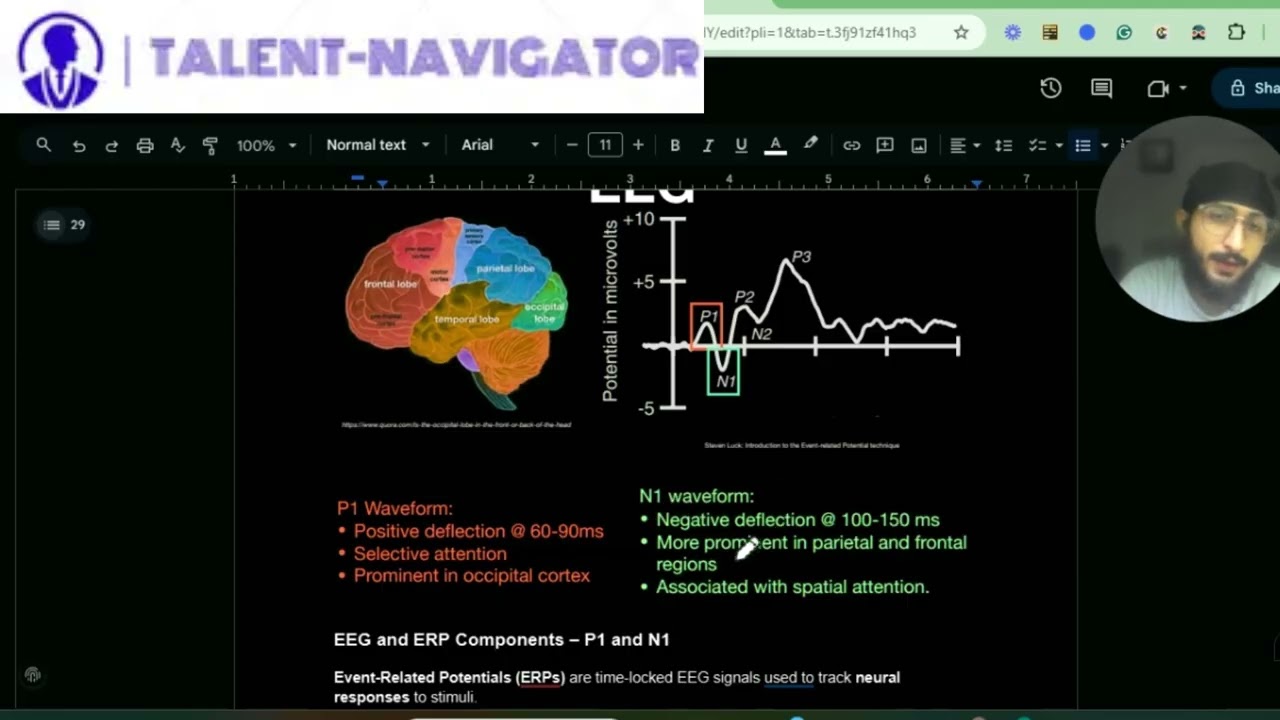
Cognitive neuroscientists often rely on Event-Related Potentials (ERPs) to dive deeper into the cognitive processing layers involved in tasks like the attentional blink. These measured brain responses illustrate how stimuli trigger specific neural pathways:
- P1 Waveform: This positive peak occurs about 60 to 90 milliseconds after stimulus presentation, reflecting early sensory processing and attention allocation in the occipital lobe.
- N1 Waveform: Appearing later, at around 150 milliseconds, this negative peak is indicative of spatial attention and selective filtering, highlighting where our cognitive resources are focused.
Insights from Experiments
The results from various experiments reveal a consistent trend: the attentional blink is resilient and persists across numerous conditions. Analyses from dual versus single tasks provide insights into the timing-sensitive nature of attentional processes. For instance:
- Performance typically shows a marked drop during the critical lag period.
- The dual task presents more significant challenges compared to the single task, reaffirming the role of cumulative cognitive load in attentional allocation.
Implications of Understanding the Attentional Blink
Understanding attentional blink phenomena has broad implications, from refining educational techniques to improving user experiences in technology. Here are some significant takeaways:
- Cognitive Resource Management: Recognizing how attention is allocated can help in designing better learning environments that respect cognitive limitations.
- User Interface Design: Technology companies must consider the attentional blink when developing applications that require rapid information processing.
- Mental Health Insights: Greater understanding of attentional limitations may inform therapeutic approaches for individuals with attention disorders.
Conclusion
The attentional blink task reveals much about the intricacies of human cognition, particularly in how we process information within very short time frames. Recognizing our limits helps in designing better systems for learning, technology use, and even enhancing our understanding of cognitive impairments. The ongoing exploration into these mechanisms not only contributes to psychology but also to fields such as neuroscience, design, and education.
Take a moment to reflect on your daily interactions with information. Consider how often the attentional blink might impact your ability to complete tasks effectively, and think about strategies you could employ to mitigate its effects. Stay curious about your cognitive functions and continue exploring the captivating world of cognitive psychology!


Comments
Post a Comment