Understanding Working Memory Components: A Comprehensive Guide
By Talent Navigator
Published Apr 20, 2025
4 min read
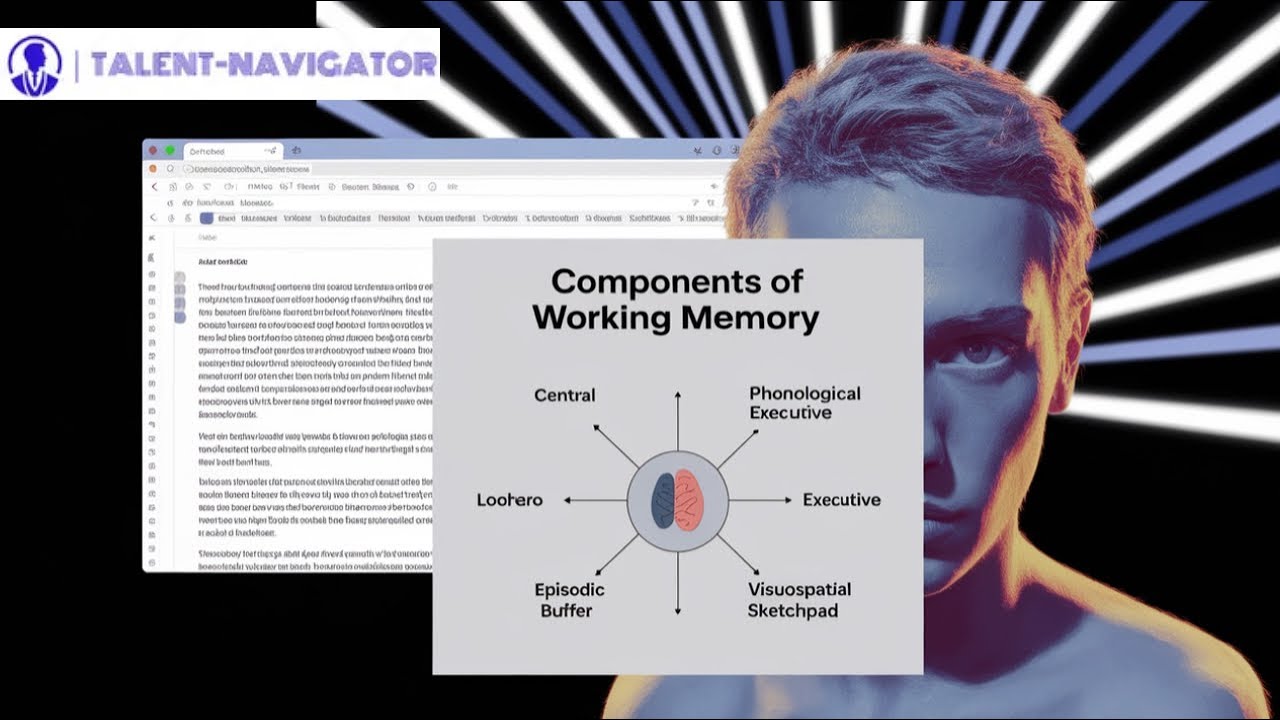
Working memory is a fundamental aspect of human cognitive function, helping us to process and manipulate information in real time. It serves as the workspace for our thoughts, allowing us to navigate the myriad stimuli the world throws at us. In this article, we will delve into the key components of working memory, examining their unique roles, significance, and the fascinating interplay between them.
What Is Working Memory?
Working memory can be understood as a limited-capacity system that temporarily holds and manipulates information necessary for complex cognitive tasks such as learning, reasoning, and comprehension. It is distinct from long-term memory, as it only retains information for short durations but is crucial for daily functioning.
The Components of Working Memory
Working memory is often described through several core components, as identified by theorists like Baddeley. Let's break down these components and their respective roles:
1. Central Executive
The central executive is the control center of working memory, directing attention and coordinating various cognitive processes. This component plays a pivotal role in decision-making and problem-solving, operating like a manager that handles multiple tasks simultaneously. Key functions include:
- Attention Control: Directs focus to relevant information, disregarding distractions.
- Resource Allocation: Decides which memory resources to utilize for specific tasks.
- Integration: Combines data from different cognitive systems to form coherent representations.
The central executive is associated with fluid intelligence, allowing individuals to adapt to new challenges through effective working memory resource management.
2. Phonological Loop
The phonological loop is primarily responsible for the processing and storage of auditory information. It plays a vital role in language comprehension and verbal learning. Its structure consists of two main parts:
- Phonological Store: Temporarily holds verbal data, like spoken words or sounds, for about 2 seconds.
- Articulatory Rehearsal Process: Allows for the repetition of information, aiding in recall (e.g., repeating a phone number to remember it).
Characteristics:
- Limited Capacity: Can hold a small amount of information, leading to confusion with similar-sounding words, known as the phonological similarity effect.
- Flexibility: Adapts to various forms of verbal processing, enhancing learning.
3. Visual-Spatial Sketch Pad
This component manages visual and spatial information, crucial for activities such as navigation and spatial awareness. Functions of the visual-spatial sketch pad include:
- Visual Processing: Analyzes characteristics like color, shape, and size.
- Spatial Processing: Tracks the location and movement of objects in space.
In practical scenarios, when navigating a new city, individuals rely on their visual-spatial sketch pad to construct a mental map, integrating their surroundings and key landmarks.
4. Episodic Buffer
Introduced by Baddeley in 2000, the episodic buffer is the newest component of working memory, serving as a link between various memory systems. Its key role is to integrate information from the phonological loop, visual-spatial sketch pad, and long-term memory into coherent, meaningful chunks of information.
Key Functions:
- Information Integration: Combines diverse sensory elements like sound, sight, and semantic information into a coherent experience.
- Temporary Storage: Acts as a holding space for chunks of information that need further processing by the central executive.
For example, when recalling a past event, the episodic buffer helps create a rich memory by merging different sensory details.
Understanding the Interaction Between Components
The components of working memory do not function in isolation; instead, they work in synergy to create a seamless cognitive experience. When we engage in complex tasks, such as solving a puzzle or recalling a detailed story, all components interact in an intricate dance. Here is how they contribute to our cognitive capabilities:
- Problem Solving: The central executive utilizes information processed by the phonological loop and visual-spatial sketch pad to draw upon past experiences retrieved from the episodic buffer and long-term memory.
- Learning New Information: As we learn new concepts, the phonological loop assists in processing verbal data while the visual-spatial sketch pad helps visualize new ideas, reinforced by the episodic buffer that links them to pre-existing knowledge.
Conclusion
Understanding the components of working memory sheds light on the complexities of human cognition. Each part—central executive, phonological loop, visual-spatial sketch pad, and episodic buffer—plays a vital role in how we process, recall, and manipulate information. This knowledge is essential for improving learning strategies, enhancing cognitive function, and crafting educational methods that foster better memory retention.
By deepening our grasp of working memory, we can develop effective tools and practices in learning environments, helping individuals harness their cognitive capabilities fully.
If you found this exploration of working memory enlightening, consider diving deeper into cognitive psychology resources or engaging in memory training exercises that can enhance these essential skills. Embrace the journey of understanding how your mind works!


Comments
Post a Comment