Maximizing Target Nodes by Connecting Two Trees in Problem 3372 Explained📄🚀
Maximizing Target Nodes in Tree Connection Problems – A Comprehensive Guide
By Talent Navigator
Published May 30, 2025
5 min read
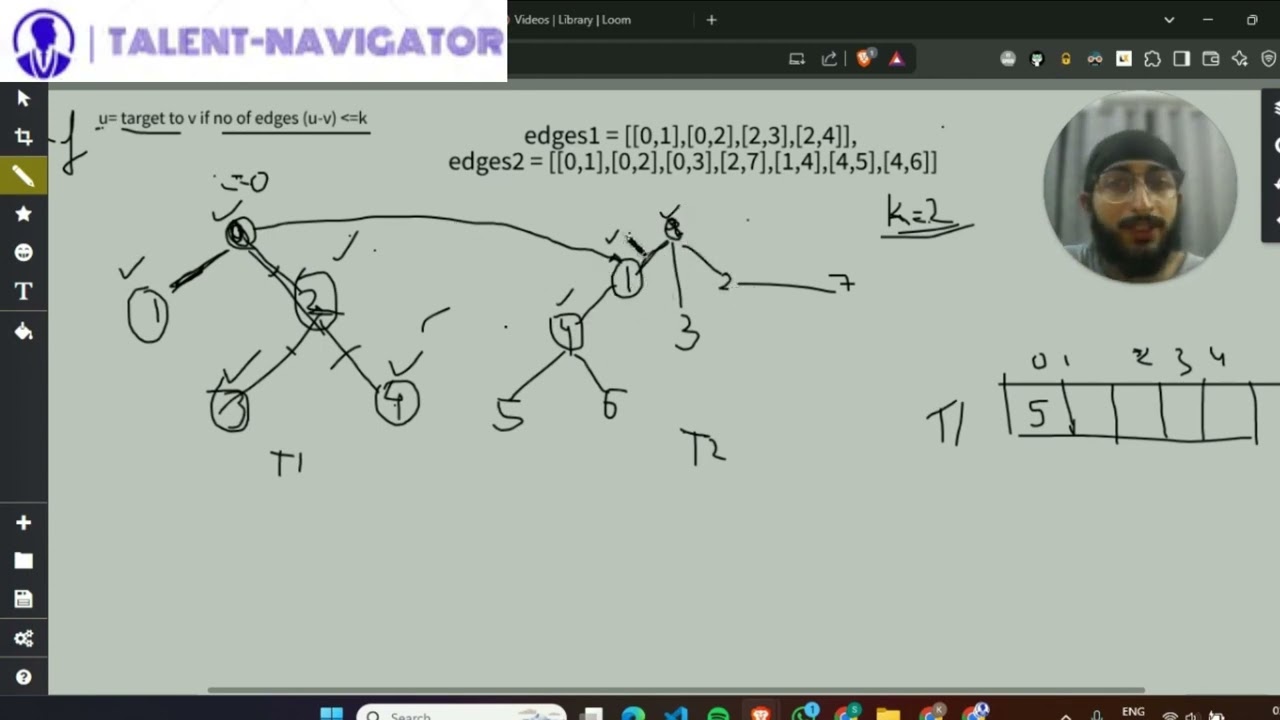
In the world of computer science and data structures, tree problems are a common challenge that often tests a programmer's skills. One such intriguing problem is the one we’re going to explore—Problem 3372, which focuses on maximizing target nodes in the context of connecting two trees. This problem not only examines tree structures but also involves concepts of graph theory and pathfinding. Understanding how to effectively solve this problem can lead to valuable insights for developers and algorithm enthusiasts alike.
Understanding the Problem Statement
At its core, Problem 3372 presents two undirected trees composed of nodes with distinct labels, ranging from 0 to n-1 for Tree 1 and 0 to m-1 for Tree 2. You are given two integer arrays, representing the edges of these trees. Let's break down the essential aspects of the problem to build a solid foundation for our solution:
Node Definition: A target node is defined based on the distance from node
uto nodev. Specifically, nodeuis a target for nodevif the number of edges in the path between them is less than or equal tok. Importantly, each node is always a target for itself.The Input Format: You receive input in the form of two integer arrays,
edges1andedges2, which contain the edges for Tree 1 and Tree 2, respectively. Each edge is defined by a pair of nodes, indicating a direct connection between them.The Output Requirement: The challenge is to return an array of size
n, where each index corresponds to the maximum possible number of target nodes that can be connected to nodeiof the first tree after establishing a connection with a node from the second tree.
Key Points to Note
- Independent Queries: Each query is independent; meaning that if you connect a node from Tree 1 to a node from Tree 2, that connection does not persist into the next query.
- Traversal Approach: The algorithm can utilize either a Depth First Search (DFS) or Breadth First Search (BFS) approach to navigate the trees and compute distances efficiently.
- Maximizing Connections: The core of the problem lies in determining which node in Tree 2 to connect to any node in Tree 1 to maximize the number of reachable target nodes.
A Step-by-Step Problem-Solving Approach
To tackle Problem 3372 effectively, follow these systematic steps:
Step 1: Construct the Trees
The first task is to construct the two trees using the provided edges. This representation will enable us to navigate through the nodes seamlessly.
- Building Trees: Each tree is built using an adjacency list based on the edges defined in the arrays. This allows for easy traversal.
Step 2: Determine Target Nodes
For each node in Tree 1, calculate how many target nodes are reachable given a distance k by using traversal:
- Single Node Reach Calculation: For any given node
i, initiate a traversal to count the number of nodes reachable within the distancek. - Self Inclusion: Always include the current node as a target.
Step 3: Explore Connections to Tree 2
Now, consider the connection possibilities between Tree 1 and Tree 2:
- Connecting Nodes: For each node from Tree 1, evaluate the potential number of target nodes that can be reached if connected to each node in Tree 2. This involves repeating the reachability count, considering the newly connected node.
- Choosing Optimal Connections: It is essential to connect to the node in Tree 2 that maximizes the number of reachable nodes. This typically involves selecting the node with the greatest degree (i.e., most connections) in Tree 2.
Step 4: Compute the Final Result
After evaluating the possible connections for each node in Tree 1, compile the maximum counts to form the resultant array:
- Store Results: Create an array to store the maximum number of reachable nodes for each node in Tree 1 after considering the best connection to Tree 2.
Step 5: Optimization and Complexity Consideration
Efficient algorithms play a pivotal role in solving tree problems like these. By leveraging properties of trees along with graph traversal techniques, you can optimize calculations:
- Expected Time Complexity: Aim for a manageable time complexity by effectively using DFS/BFS, leading to overall processing that remains efficient even as
nandmgrow significantly.
Conclusion
Problem 3372 is a fascinating computational challenge that merges aspects of tree structures with pathfinding logic. By approaching it methodically—constructing trees, counting target nodes, exploring optimal connections, and finally compiling the results—you can navigate through this problem effectively.
Understanding how to maximize the number of target nodes through strategic connections offers valuable insights into graph theory applications, enhancing your problem-solving toolkit.
Ready to tackle this problem or dive deeper into tree traversal techniques? Remember that practice and exploration are key to mastering concepts at this intersection of data structures!


Comments
Post a Comment